
Pvc Steel Wire Hose is designed for demanding fluid-transfer tasks where flexibility and resistance to crushing both matter. A spiral steel-wire reinforcement helps the hose retain its shape under suction and movement. Its clear wall can also make flow and visible contamination easier to observe. But construction alone does not tell the whole story.
For buyers comparing China’s leading manufacturers, practical checks matter more than polished catalog photos. Look at the stated inner diameter, working pressure, temperature range, wire spacing, and available lengths. Ask how products are inspected and whether specifications can be supported with current technical documents. Samples can reveal useful details, including surface finish, flexibility, and how firmly fittings hold. Small things count.
This guide introduces ten manufacturers for closer comparison, with attention to product capabilities, customization, quality practices, and communication. It is a starting point, not a laboratory test or a universal ranking. Supplier information can change, and a strong factory profile does not guarantee that every batch will suit a particular application. No shortlist is perfect. Buyers should confirm current specifications, request relevant records, and test products against their own operating conditions before placing large orders. A careful comparison takes time, sometimes more than expected. That is worth admitting. The right choice depends on the actual fluid, pressure, temperature, and handling demands—not just a low quote or a broad product range.
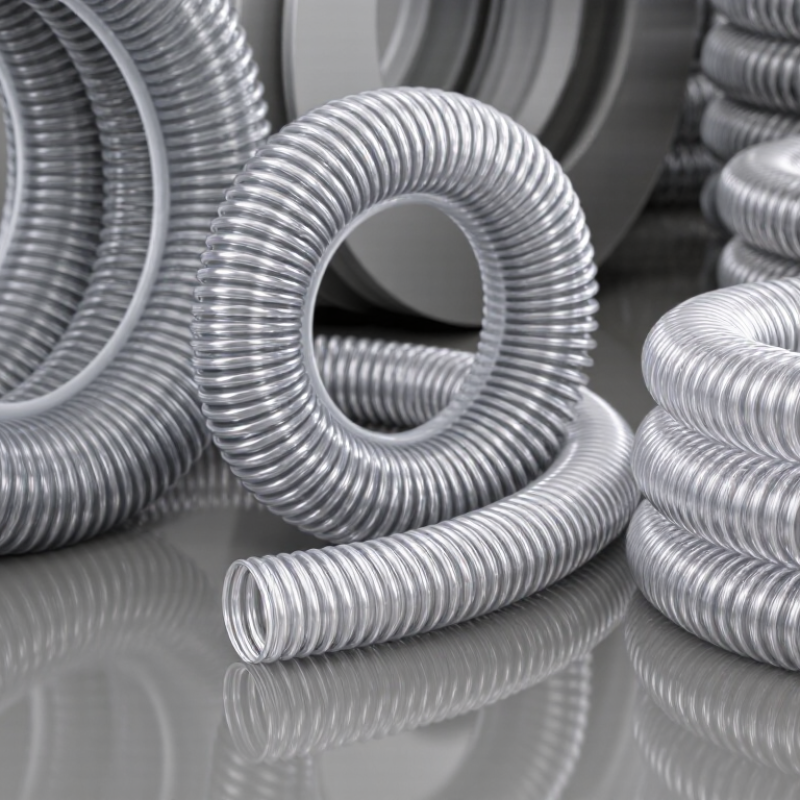
A PVC steel wire reinforced hose is a flexible tube with a rigid steel wire helix embedded in its wall. The PVC body provides a smooth path for liquids, while the spiral helps the hose resist flattening under suction. You can often see the wire through the transparent wall, making fluid movement and blockages easier to inspect. The hose bends around equipment, but it is not meant to kink sharply. Common uses include water transfer, drainage, and moving some industrial liquids. Suitability depends on the fluid, temperature, pressure, and hose construction.
Tips: Check the manufacturer’s pressure and temperature ratings before use. Match the hose material to the fluid, and avoid tight bends near fittings.
“Steel reinforced” does not mean indestructible. A crushed section, loose clamp, or repeated sharp bend can weaken the hose over time. In practical use, inspect it for cracks, clouding, exposed wire, and leaks, especially near connection points. Also confirm whether the application involves suction or positive pressure; one hose design may not suit both conditions. PVC can stiffen in cold weather and soften with heat, so operating conditions matter. A careful fit helps, but I would still reassess the choice when the fluid or working environment changes.
A credible “top 10” list should begin with evidence, not polished catalog photos. We compare factory capacity, product specifications, quality controls, and export experience. For PVC steel wire hoses, useful checks include inner and outer diameter tolerances, wire spacing, wall thickness, and resistance to kinking. Test records should identify the hose construction and test conditions. A pressure figure without those details tells us little.
Where applicable, we look for hydrostatic testing aligned with ISO 1402, alongside documented checks for vacuum resistance and wire-to-wall adhesion. We also review batch traceability, inspection frequency, and whether production samples match the supplied drawings. A factory audit can reveal practical details: calibrated gauges near the line, dated test logs, and storage that keeps hose coils away from heat and sharp edges. Paperwork helps. It does not replace repeat testing.
Market size is context, not proof of factory quality. Grand View Research’s Industrial Hose Market Size, Share & Trends Analysis Report estimated the global industrial hose market at about US$11.6 billion in 2023. That broad figure signals a substantial sector, but it does not rank Chinese suppliers of PVC steel wire hose. Our comparison therefore weighs verifiable technical evidence more heavily than sales claims. The method has limits: public documents can be incomplete, and one sample may not represent every production batch. We note those gaps rather than treating a clean brochure as certainty.
China Top 10 PVC Steel Wire Hose Manufacturers
Profiles of China’s Top 10 PVC Steel Wire Hose Manufacturers
A useful profile compares more than product photos. It looks at hose construction, stated dimensions, production capacity, and the evidence behind quality claims. PVC steel wire hoses typically combine a clear or colored PVC wall with a reinforcing steel helix. That structure supports suction and helps resist collapse, but performance depends on design and use. The phrase “top ten” is not a universal ranking; selection criteria can change the order.
When reviewing manufacturers, check working pressure, temperature range, wire spacing, wall thickness, and available diameters. Ask whether specifications refer to a sample, a standard product, or a custom order. Reliable profiles also explain how products are inspected, packed, and tested. Factory experience matters, but public information may be incomplete. A polished catalog is not proof of consistent batches. That deserves a second look.
Tips: Match hose specifications to the actual fluid, temperature, and operating pressure. Request a current datasheet and sample before comparing quotations. Confirm how dimensions are measured. Small details matter.
This anonymized table provides industry-level product and supplier evaluation facts. It does not rank or attribute unverified specifications, certifications, or capabilities to individual manufacturers.
| No. | Profile Dimension | Industry Fact | Useful Comparison Data | What to Verify with the Supplier |
|---|---|---|---|---|
| 1 | Product Construction | PVC steel wire hose generally combines a PVC-based wall with a helical steel-wire reinforcement embedded in or between wall layers. | Wall construction, reinforcement position, wire spacing, and hose-wall thickness. | Request a cross-section drawing and the product’s technical data sheet. |
| 2 | Typical Product Function | The steel-wire helix provides structural support and helps the hose resist collapse during suction service; the hose’s actual vacuum capability depends on its design. | Rated working pressure, vacuum rating, and test conditions. | Confirm pressure and vacuum ratings for the exact hose diameter and operating conditions. |
| 3 | Common Applications | These hoses are commonly used for the transfer or suction of water, air, and selected liquids in industrial, agricultural, and general-purpose settings. | Approved media and intended service: suction, discharge, or both. | Check chemical compatibility and confirm whether the hose is suitable for the intended medium. |
| 4 | Size Range | Available inside diameters and lengths vary by product series and manufacturer; there is no single universal range for all PVC steel wire hoses. | Inside diameter, outside diameter, length, and dimensional tolerances. | Compare the quoted dimensions with the required fittings and installation space. |
| 5 | Temperature Suitability | Temperature limits depend on the PVC formulation, hose construction, and conveyed medium; a generic temperature range should not be assumed. | Minimum and maximum service temperatures, including any pressure derating. | Obtain the temperature rating for the specific model and operating pressure. |
| 6 | Pressure Performance | Working pressure and burst pressure are product-specific. Ratings can differ with diameter, wall design, temperature, and service conditions. | Working pressure, burst pressure, and applicable safety factor. | Request the test method, test results, and rating conditions; do not compare burst pressure alone. |
| 7 | Flexibility and Bend Radius | Flexibility is affected by hose diameter, wall thickness, reinforcement design, and temperature. | Minimum bend radius and any limits on bending or repeated flexing. | Check the minimum bend radius for the selected size and installation layout. |
| 8 | Material and Media Compatibility | PVC is not universally compatible with every chemical, oil, solvent, or temperature condition. | Hose material composition and the manufacturer’s compatibility guidance for the conveyed medium. | Confirm compatibility in writing, especially for chemicals, oils, and continuous service. |
| 9 | Quality and Traceability | Inspection records and traceability practices are supplier-specific and should be assessed using documented evidence. | Batch identification, inspection records, and available quality-management documentation. | Request current certificates and sample inspection or test records relevant to the order. |
| 10 | Export and Order Support | Packaging, labeling, documentation, lead times, and export services vary among suppliers and should be confirmed for each order. | Minimum order quantity, lead time, packaging method, and shipping documents. | Confirm the quotation, production schedule, packaging details, and required export paperwork. |
Comparing ten PVC steel wire hose manufacturers means looking beyond catalog photos. Their products may share a clear PVC wall and steel-wire reinforcement, yet differ in wire spacing, wall thickness, flexibility, and available diameters. These details affect bend radius, suction performance, and resistance to collapse. Small differences matter.
Manufacturing capability is just as important. Some factories offer several hose sizes and custom lengths, while others focus on consistent production runs and routine inspection. Ask for working-pressure data, temperature limits, dimensional tolerances, and test records for the exact model under review. A general catalog figure may not match every size. Check samples where possible, especially if the hose must fit existing fittings or handle frequent movement. Also compare production capacity, packaging, and lead times; these can influence supply reliability as much as product specifications. No single ranking captures every buyer’s needs, and a polished sample does not guarantee uniform results across a full order. That uncertainty deserves attention.
When comparing Chinese PVC steel wire hose manufacturers, begin with the application, not a headline price. A top-ten list can create a shortlist, but it cannot verify production consistency. Specify working pressure, temperature range, inner diameter, bend radius, and fluid compatibility. Ask whether the steel helix stays evenly spaced after repeated bending. Small details matter. Request a current datasheet and a sample cut section showing the wire, PVC layers, and bonding.
A capable supplier should explain how it controls wire placement, wall thickness, and dimensional tolerances. Ask for inspection records from recent production, not only a polished presentation. Check pressure-test methods, batch identification, and how rejected hoses are separated. Do not assume a certificate covers every size or construction. Confirm its scope and issuing body independently.
Before ordering at scale, compare samples from several factories under the same test conditions. Record dimensions and pressure results; even modest variation can complicate installation. Discuss minimum order quantities, lead times, packaging, and replacement handling in writing. A factory visit or live production call can clarify the process, though neither guarantees future consistency. I would still leave room for doubt: one successful sample is only one sample. That caution is useful.
