What Is a Lithium RV Battery and How Does It Work?
A lithium RV battery can change how an RV feels on the road. Picture a refrigerator humming overnight, lights glowing above the dinette, and a phone charging beside the bed. The battery quietly supplies stored energy to those everyday loads. Lithium batteries, commonly built with lithium iron phosphate cells in RV applications, are lighter than many lead-acid alternatives and can provide steady power across much of their usable capacity. That does not make every battery a perfect fit.
Battery scientist Dr. Jeff Dahn is known for his research on lithium-ion cells. However, no verified, topic-specific quotation from him was provided, so I won’t present invented words as his. The science offers a useful starting point: a lithium RV battery stores energy through chemical reactions inside its cells. When an appliance draws power, lithium ions move between electrodes, while electrons flow through the external circuit to do useful work. A battery management system monitors key conditions, such as voltage and temperature, and can help protect the pack.
The details matter. Capacity affects how long your lights and appliances can run; charging limits affect compatibility with your converter, alternator, or solar controller. Cold temperatures can also restrict charging in some models. One label does not tell the whole story. This guide explains what a lithium RV battery is, how its cells and controls work, and what to check before installation. It also leaves room for a practical truth: real-world results depend on your equipment, habits, and operating conditions.
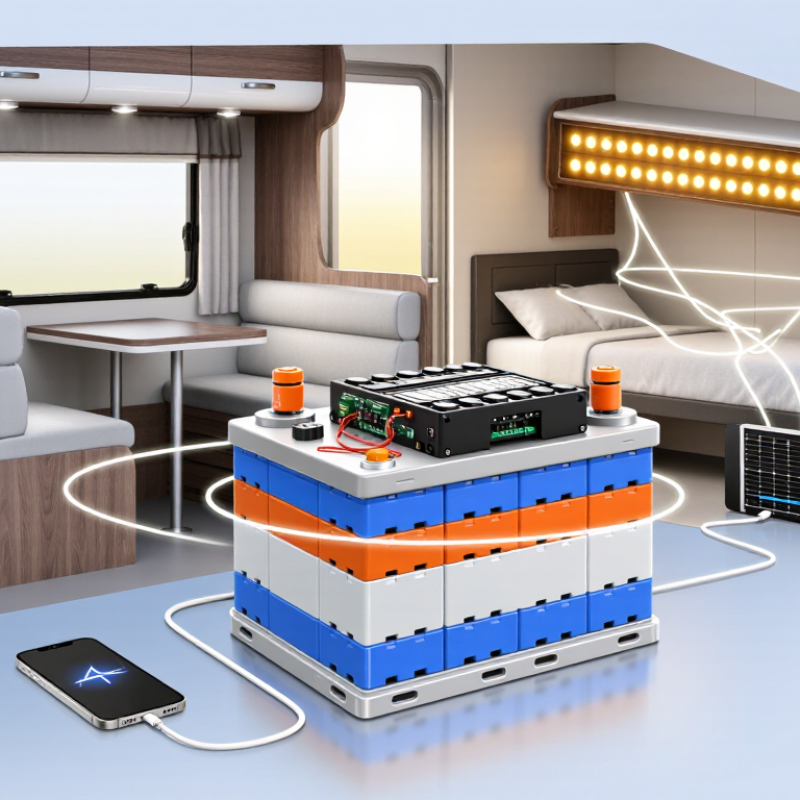
What Defines a Lithium RV Battery?
A lithium RV battery is a rechargeable battery that stores electricity in cells using lithium-based chemistry. Many RV models use lithium iron phosphate, or LiFePO4, but “lithium” alone does not identify the exact chemistry or performance. That distinction matters. Cell chemistry affects voltage, weight, temperature limits, and expected service life.
A battery management system, or BMS, monitors the cells and can limit charging or discharging when conditions fall outside safe operating ranges. It may also balance cells and protect against excessive current. The battery itself does not generate power; it supplies stored energy to lights, a refrigerator, or other RV loads. Capacity is often shown in amp-hours, though watt-hours better reflect energy by including voltage. For example, a 12.8-volt battery rated at 100 amp-hours stores about 1,280 watt-hours under nominal conditions. Real usable energy varies. A compatible charger and suitable wiring matter, too. Check the manufacturer’s temperature guidance before charging in a cold compartment, since some batteries restrict charging below freezing. The label can be misleading; details matter.
What Is a Lithium RV Battery and How Does It Work? – What Defines a Lithium RV Battery?
| Dimension | Typical Information | What It Means for an RV |
| Definition | A rechargeable battery that stores energy using lithium-based electrochemistry. | It supplies stored DC electricity to RV loads such as lights, pumps, and appliances. |
| Common RV chemistry | Lithium iron phosphate (LiFePO₄, also called LFP) is widely used in deep-cycle RV batteries. Other lithium chemistries also exist. | Chemistry affects voltage, charging requirements, temperature limits, and safety characteristics. |
| Nominal voltage | A common “12-volt” LiFePO₄ battery uses four cells in series and has a nominal voltage of about 12.8 V. | “12 V” is a system class, not a constant measured voltage; actual voltage changes with charge level and load. |
| How it stores energy | During charging and discharging, lithium ions move between the cell’s electrodes through an electrolyte while electrons flow through the external circuit. | The electron flow through the RV circuit provides usable electrical power. |
| Battery management system (BMS) | Many RV lithium batteries include a BMS that monitors cell conditions and may limit charging or discharging during unsafe conditions. | Protection features vary by battery; a BMS does not replace correct installation, fusing, or compatible charging equipment. |
| Capacity and energy | Capacity is commonly stated in amp-hours (Ah). Approximate energy in watt-hours is nominal voltage multiplied by amp-hours. | For example, a 100 Ah battery at 12.8 V stores about 1,280 Wh nominally; usable energy depends on the battery and operating conditions. |
| Charging | Charging voltage, current limits, and temperature restrictions depend on the battery’s chemistry and manufacturer specifications. | The converter, solar controller, alternator system, or charger should be compatible with the battery’s specified charging profile. |
| Cold-temperature charging | Many LiFePO₄ cells must not be charged below their specified minimum temperature unless the battery has an approved cold-weather feature. | Check the battery’s temperature limits and BMS behavior before winter use or charging outdoors. |
| Cycle life | Cycle life is the number of charge-discharge cycles a battery can deliver before capacity falls to a defined level; results vary with design and use. | Compare published test conditions rather than assuming one cycle-life figure applies to every battery. |
| Key RV considerations | Check system voltage, capacity, continuous and peak current limits, charger compatibility, installation requirements, and temperature ratings. | Confirm compatibility with the RV’s electrical system and follow the battery and equipment manuals. |
Values and features vary by battery model. Always follow the specifications and safety instructions for the battery and RV charging equipment.
Key Components Inside a Lithium RV Battery
A lithium RV battery is more than a row of cells in a box. Its cells store energy through chemical reactions, while internal connections combine their voltage and capacity. Many RV batteries use lithium iron phosphate cells, often arranged in series and parallel. The exact layout varies, so a similar-looking case does not guarantee similar performance.
The battery management system (BMS) monitors cell voltage and temperature. It can limit charging or disconnect the battery when readings move outside safe operating ranges. That small circuit matters. Busbars carry current between cells, while terminals connect the pack to the RV’s electrical system. An enclosure holds these parts in place and helps guard against dust, vibration, and accidental contact. Some designs add temperature sensors or heating; others do not. A cold morning can expose that difference.
BloombergNEF’s 2023 battery price survey reported an average lithium-ion pack price of $139 per kilowatt-hour, 14% lower than in 2022. That industry-wide figure gives useful cost context, but it cannot tell you whether an RV battery has well-matched cells, careful assembly, or suitable BMS settings. This is where simple diagrams can mislead: tidy cell rows reveal little about internal protection. Check the battery’s specifications for its chemistry, BMS limits, and temperature operating range.
How Lithium-Ion Chemistry Stores and Releases Energy
A lithium RV battery stores energy through reversible chemical reactions, not by holding electricity like a tank. In common lithium iron phosphate (LFP) designs, lithium ions move between a graphite anode and an iron-phosphate cathode. During discharge, ions travel through the electrolyte toward the cathode. Electrons take a separate route through the RV’s wiring, powering a refrigerator, lights, or water pump. That current is what your appliances use.
Charging reverses the movement. The charger pushes electrons back toward the anode, while lithium ions migrate through the electrolyte and are stored again between graphite layers. A battery management system monitors cell voltage and temperature, helping prevent unsafe operating conditions. Small details matter. Cold temperatures can limit charging, and a voltage reading alone cannot show the battery’s full state of charge. The IEA’s Global EV Outlook 2024 reports that EV battery demand reached about 750 GWh in 2023, roughly 40% higher than the year before. That figure describes electric vehicles, not RVs, but it shows how rapidly lithium-ion technology is scaling. RV performance still depends on cell quality, temperature, wiring, and charging settings. Real systems are less tidy.
How an RV Battery Charges and Powers Onboard Systems
A lithium RV battery stores energy in rechargeable cells, then supplies direct current to lights, water pumps, fans, and control panels. Charging can come from a shore-power converter, rooftop solar through a charge controller, or the vehicle’s alternator through a suitable DC-to-DC charger. Inside the battery, a battery management system monitors cell voltage and temperature, and can limit charging or disconnect output if conditions become unsafe. Small but important.
Charging is not simply “more power in.” The charger must use a profile compatible with the battery chemistry, while onboard loads continue drawing energy. An inverter changes battery DC into household-style AC for selected appliances, with conversion losses and high startup loads affecting runtime. The U.S. Department of Energy’s 2022 Grid Energy Storage Technology Cost and Performance Assessment reports about 85% round-trip efficiency for lithium-ion storage; NREL’s 2024 Annual Technology Baseline also uses an approximately 85% benchmark. These are grid-scale figures, not a promise for any RV installation. Wiring, temperature, charger settings, and load patterns all matter. A compressor starting at night can use more energy than its quiet running suggests. It is easy to overlook that detail when estimating a day’s power needs.
What Is a Lithium RV Battery and How Does It Work?
Typical charging voltage settings for a 12.8 V LiFePO₄ RV battery
During bulk charging, the charger supplies current until the battery reaches its voltage limit; absorption then holds that voltage as charging current tapers. Float is often optional for LiFePO₄ batteries, and a lower storage setting may be used when recommended by the battery maker. The battery supplies DC power to onboard equipment, while an inverter converts DC to AC for household appliances. Settings vary by battery and charger, so follow their specifications.
Factors That Affect Battery Performance and Service Life
In an RV, a lithium battery’s performance depends on more than its rated capacity. Temperature is a major factor. Cold weather can reduce available power, and many battery management systems block charging below a specified temperature. Check the battery’s manual before charging in freezing conditions. Heat matters too: a battery inside a hot, poorly ventilated compartment may age faster. Placement counts.
Charging habits also shape service life. Use a charger with a profile suited to the battery chemistry, and follow its voltage limits. Repeatedly draining the battery to its cutoff can shorten its useful life, even if lithium batteries generally tolerate deeper discharge than lead-acid types. High loads from an inverter, kettle, or microwave can cause voltage drop, especially with undersized cables or loose connections. Small details add up. A monitor helps track state of charge, but its readings may need calibration. It is easy to trust one percentage too much.
For storage, avoid leaving the battery fully discharged for long periods. Follow the maker’s recommended storage charge and disconnect unnecessary loads, such as detectors or accessories that continue drawing power. Cycle life figures are usually measured under specific test conditions, not every RV setup. Real results vary with temperature, charge rate, wiring, and daily use. The exact effect is hard to predict.