
Choosing the right ventilation equipment can shape airflow, energy use, noise levels, and maintenance costs. For global buyers, Axial Duct Fans offer a practical solution where air must travel through ducts with limited resistance. Their compact structure suits warehouses, factories, tunnels, commercial buildings, and agricultural facilities.
However, performance depends on more than diameter or motor power. This guide examines ten common types, including standard tube-axial, vane-axial, high-temperature, explosion-protected, smoke-extraction, and adjustable-pitch models. Each design responds to different operating conditions. Air volume, static pressure, temperature, humidity, installation length, and control method all require careful review. A fan that performs well in a short duct may struggle in a long system with multiple bends.
Small details matter. A 500-millimeter fan may fit the opening but fail to deliver the expected airflow after filters and dampers are installed. Motor efficiency, bearing quality, blade material, vibration control, and access for cleaning also affect long-term value. That assumption fails.
Reliable selection should combine manufacturer data, tested performance curves, installation experience, and local electrical requirements. Buyers should request complete datasheets, sound ratings, protection classes, warranty terms, and spare-parts information. Certifications may vary by destination, so compliance should be verified before purchase.
No single fan fits every site. This overview provides a practical comparison, but real projects still need engineering checks. Field conditions can expose weaknesses that catalog pages do not show.
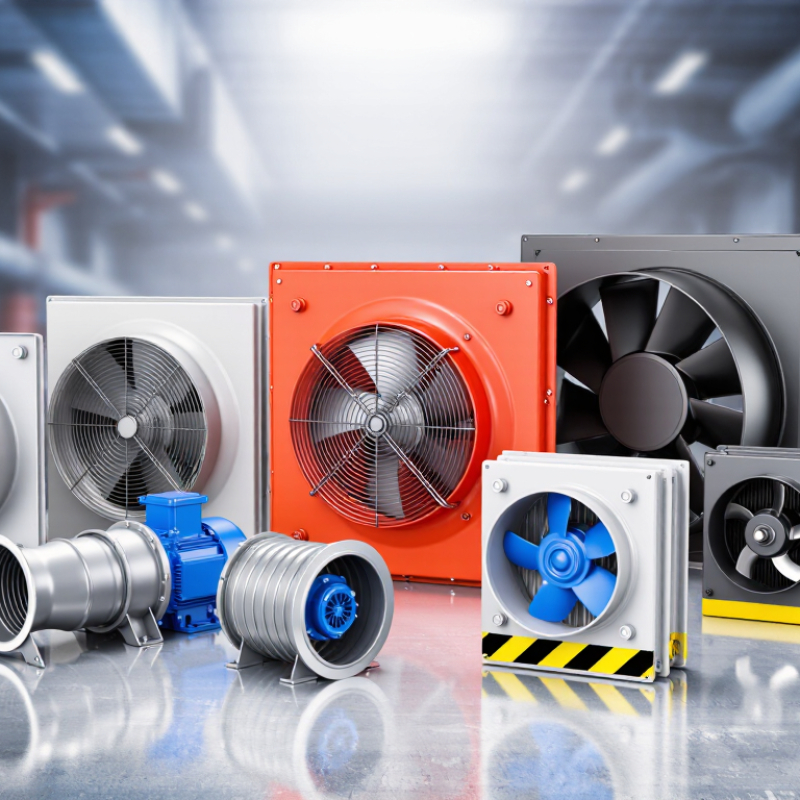
An axial duct fan moves air parallel to its rotating shaft. Its impeller creates airflow through a cylindrical housing. This design suits ventilation routes with relatively low or moderate resistance. Common applications include warehouses, tunnels, workshops, and equipment rooms.
The motor transfers torque to the impeller. Angled blades then push air forward. Blade pitch affects airflow, pressure, noise, and power demand. A larger pitch may increase pressure, but it can also overload the motor. The fan curve shows how airflow changes as duct resistance rises. Long ducts, sharp bends, filters, and grilles can reduce actual performance.
Selection should begin with measured airflow and estimated system pressure. Nominal diameter alone is not enough. During site checks, I compare the specified duty point with the operating fan curve. This simple step often reveals optimistic assumptions. In practice, our first estimate can be wrong. A slightly oversized fan may waste energy and create unnecessary noise. A smaller unit may fail to overcome resistance.
Installation quality also affects operation. The impeller needs adequate clearance from the housing. Flexible connectors can reduce vibration transfer. Poor alignment may produce uneven sound and bearing wear. Inspectors should check rotation direction, fasteners, electrical protection, and access for cleaning. Dust buildup changes blade shape and balance. It is easy to overlook. Temperature, humidity, corrosion risk, and local electrical requirements also influence material and motor selection for international projects.
Axial duct fans are best classified by airflow path, blade control, drive arrangement, and duty. The ten main types include propeller, tube-axial, vane-axial, jet-axial, fixed-pitch, variable-pitch, direct-drive, belt-drive, reversible, and smoke-extraction high-temperature fans. Propeller fans move large air volumes at low resistance. Tube-axial models add a cylindrical casing for cleaner duct connection. Vane-axial fans use guide vanes to improve pressure and airflow stability. Jet-axial units support garage ventilation and tunnel air movement. Small details matter.
Fixed-pitch fans offer simpler maintenance, while variable-pitch designs adjust blade angle for changing demand. Direct-drive construction reduces belt losses and alignment work. Belt-drive fans allow motor access and speed changes, but require inspection. Reversible fans change airflow direction, although performance can drop in reverse operation. High-temperature smoke-extraction fans use heat-resistant materials and strict emergency-duty ratings. This classification is useful, but not perfectly clean; one fan may belong to several groups.
The International Energy Agency’s Energy Efficiency Market Report identifies electric motors as responsible for roughly 45% of global electricity consumption, making fan efficiency commercially important. The U.S. Department of Energy’s Industrial Decarbonization Roadmap also places motor-driven equipment at about 68% of industrial electricity use. Buyers should compare tested airflow, static pressure, sound, efficiency, and duty temperature under AMCA 210 or ISO 13349 terminology. A larger impeller is not automatically better. System resistance, filter loading, duct bends, and operating hours can change the real result. Check the operating point, not only the catalog maximum.
| Classification | Axial Duct Fan Type | Primary Airflow Direction | Typical Construction | Indicative Airflow Range | Indicative Static Pressure | Typical Temperature Capability | Common Applications | Key Advantages | Main Selection Considerations |
|---|---|---|---|---|---|---|---|---|---|
| 01 | Propeller Axial Fan | Parallel to the rotating shaft | Open propeller, motor, guard, and wall plate or short casing | 1,000–60,000 m³/h | Up to 150 Pa | Normally up to 40–60°C | General ventilation, warehouses, workshops, agricultural buildings, and heat removal | Simple construction, high free-air volume, low purchase and maintenance cost | Best for low-resistance systems; performance drops significantly when duct resistance increases |
| 02 | Tube Axial Fan | Parallel to the shaft through a cylindrical casing | Rotor and motor installed inside a tubular housing; commonly fitted with guide flanges | 1,000–100,000 m³/h | 100–800 Pa | Normally up to 40–80°C, depending on motor and materials | Supply and exhaust ductwork, factories, tunnels, garages, and process ventilation | Compact in-line installation and better duct pressure capability than open propeller fans | Check casing diameter, system resistance, noise level, motor cooling, and access for maintenance |
| 03 | Vane Axial Fan | Parallel to the shaft with guided flow | Tube casing with fixed or adjustable guide vanes before or after the impeller | 2,000–150,000 m³/h | 300–2,000 Pa | Normally up to 40–80°C | Long duct systems, industrial ventilation, cooling plants, and large air-handling systems | Higher pressure capability and improved flow straightening compared with basic tube axial designs | Requires correct operating point; guide-vane settings and system turbulence affect efficiency and noise |
| 04 | Variable-Pitch Axial Fan | Parallel to the shaft | Impeller blades with adjustable pitch, either manually or through an automatic control mechanism | 5,000–250,000 m³/h | 500–3,000 Pa | Typically 40–80°C; special designs allow higher temperatures | Mining, power generation, process plants, cooling towers, and systems with changing airflow demand | Wide operating range and efficient capacity control without relying only on throttling dampers | Higher mechanical complexity; blade pitch, actuator reliability, balancing, and control compatibility are important |
| 05 | Reversible Axial Fan | Forward and reverse operation through bidirectional rotation or blade adjustment | Reversible impeller geometry with motor and controls designed for airflow reversal | 2,000–120,000 m³/h | 150–1,500 Pa | Normally up to 40–60°C | Underground facilities, tunnels, car parks, emergency ventilation, and reversible process systems | Can provide supply and exhaust ventilation using the same fan installation | Reverse airflow usually has different efficiency and pressure performance; verify both operating directions |
| 06 | Jet or Impulse Axial Fan | Produces a high-velocity air jet along the tunnel or room axis | Short casing, axial impeller, silencers, mounting brackets, and optional airflow reversal | 5,000–80,000 m³/h | 200–1,500 Pa thrust-generating pressure | Standard models commonly 40–60°C; fire-rated models may be certified for 250–400°C for limited durations | Smoke control and longitudinal ventilation in road tunnels, basement car parks, and large enclosed spaces | Moves air without a full-length duct network and supports smoke movement control | Selection depends on thrust, induction effect, tunnel geometry, noise, fire rating, and mounting clearances |
| 07 | Smoke-Extract Axial Fan | Parallel to the shaft for normal exhaust or emergency smoke extraction | Heat-resistant impeller, casing, motor arrangement, insulation, and fire-rated electrical components where required | 5,000–200,000 m³/h | 500–2,500 Pa | Common certified classes include 250°C for 2 hours or 300°C for 1 hour; certification varies by standard | Car parks, smoke-control zones, industrial buildings, atriums, and fire-safety ventilation systems | Designed to maintain emergency exhaust performance under specified fire conditions | Confirm the required fire-test classification, duration, installation position, control panel, and local code approval |
| 08 | High-Temperature Process Axial Fan | Parallel to the shaft through a process-air casing | Heat-resistant steel or alloy components, external motor, shaft cooling, or separated bearing arrangement | 2,000–150,000 m³/h | 300–2,000 Pa | Approximately 80–500°C, depending on design and cooling method | Ovens, kilns, dryers, furnaces, foundries, and hot-gas circulation systems | Suitable for continuous or intermittent handling of hot process air | Specify gas temperature, dust content, corrosiveness, operating duration, materials, and shaft-seal requirements |
| 09 | Bifurcated Axial Fan | Parallel to the shaft with the motor isolated from the airstream | Split or bifurcated casing that separates the motor compartment from the conveyed air | 1,000–80,000 m³/h | 300–1,500 Pa | Typically up to 80–150°C; higher ratings require specialized construction | Corrosive, humid, dusty, or contaminated air in chemical, plating, wastewater, and process facilities | Protects the motor from direct contact with aggressive or contaminated air | Inspect casing materials, drainage, shaft sealing, corrosion resistance, and motor cooling arrangements |
| 10 | Roof-Mounted Axial Exhaust Fan | Usually vertical upward discharge | Weatherproof roof curb, axial impeller, protective cowl, motor, and optional backdraft damper | 1,000–100,000 m³/h | 50–600 Pa | Normally up to 40–60°C; special versions are available for hot or smoke exhaust | Factory roofs, commercial buildings, warehouses, kitchens, livestock buildings, and general exhaust systems | Saves indoor floor space and discharges contaminated air above the roofline | Verify roof curb dimensions, weather exposure, discharge clearance, vibration isolation, and maintenance access |
Global buyers may compare propeller, tube axial, vane axial, mixed-flow, jet, reversible, bifurcated, smoke-extract, high-temperature, and low-noise fans. Each design serves a different duty point. The real comparison begins with airflow, static pressure, efficiency, sound, and control response. A fan delivering 20,000 m³/h is not automatically better. It may consume more power under restricted duct conditions.
The International Energy Agency reports that buildings used about 30% of global final energy in 2022. This makes fan efficiency commercially important. Request performance data at the actual operating point, not only at free-air conditions. AMCA 208 introduces the Fan Energy Index, which helps compare electrical demand across fan systems. Check motor efficiency, speed control, pressure recovery, and service access. Field commissioning often exposes errors in catalogue selection. A clean datasheet can still hide unstable airflow or excessive noise. That deserves reflection.
Choosing the right axial duct fan starts with the system, not the catalog. Common options include propeller, tube axial, vane axial, jet, reversible, roof, inline, high-temperature, smoke-extraction, and compact panel fans. Each design moves air differently through resistance. Propeller fans suit open, low-pressure paths. Tube and vane axial fans handle duct resistance more effectively. Jet fans support directional airflow in large spaces.
Do not select by airflow alone. Measure the required air volume and static pressure at the actual duty point. Then check duct diameter, bends, filters, louvers, and discharge length. These details can reduce delivered airflow.
Noise matters. In offices, hospitals, and workshops, sound levels can shape user acceptance. Review the fan curve, motor efficiency, temperature range, ingress protection, and control method.
Variable-speed control may save energy, but poor commissioning can create unstable operation. Installers should verify rotation, clearances, vibration, and access for cleaning. Use documented test data and applicable electrical and safety requirements.
Field experience shows that oversized fans often run noisily and inefficiently. Perfection is rare. Real systems rarely match drawings perfectly. Recheck assumptions after installation, especially when airflow feels weak or vibration appears. Small mistakes become expensive.
Top 10 Types of Axial Duct Fans for Global Buyers
Global Purchasing, Standards, Installation, and Maintenance Considerations
Global buyers commonly compare propeller, tube-axial, vane-axial, bifurcated, jet, roof, reversible, high-temperature, corrosion-resistant, and smoke-extract fans. The correct choice depends on airflow, static pressure, temperature, noise, and operating hours. The U.S. Department of Energy notes that fan systems may consume 10–20% of electricity in industrial facilities. Efficiency deserves attention.
Request certified performance curves, not only catalog airflow. ANSI/AMCA 210 supports laboratory testing for air performance, while ISO 13349 clarifies fan terminology. Regional electrical, fire-safety, and electromagnetic requirements still vary. IEA efficiency analysis places motor-driven systems at roughly half of global electricity use. Small motor losses become expensive over time.
Measure twice.
Installation needs a straight inlet, flexible connectors, secure anchors, and vibration isolation. Check motor enclosure ratings, variable-speed-drive compatibility, altitude, and ambient temperature. A neat specification can still fail when duct transitions create turbulence. That mistake is common. During maintenance, inspect bearings, fasteners, guards, belts, corrosion, and impeller balance. Record vibration and current readings monthly where operation is critical. Replace damaged filters and clean blades without bending them. Maintenance intervals should follow actual dust, moisture, and temperature conditions, not an optimistic calendar.
