
Vaping Sensors are becoming a practical part of indoor air-quality monitoring. They can help identify vaping-related aerosol events, but performance varies by sensing method, room conditions, and device placement. Buyers comparing China’s manufacturers should look beyond a product label. Response time, detection range, calibration needs, false alarms, and after-sales support all deserve attention.
The World Health Organization reported in 2023 that about 100 million people worldwide used e-cigarettes, including at least 15 million adolescents aged 13–15. That figure describes use, not sensor demand. Still, it shows why reliable environmental monitoring matters in shared spaces. Dr. Ruediger Krech, WHO Director of Health Promotion, said: “E-cigarettes are harmful to health and are not safe.” His warning concerns health, not sensor performance; the distinction matters.
There is no single public standard that makes every “vaping detector” directly comparable. Some products use particulate or gas-sensing approaches, and each can respond differently to humidity, cleaning sprays, or ordinary aerosols. Small details count. A clear datasheet should state test conditions, alarm thresholds, maintenance intervals, and known limitations. Buyers should also request sample reports and verify claims through controlled trials before placing large orders. This guide reviews ten Chinese manufacturers through a buyer-focused lens, while recognizing that factory capability and product quality can change. One limitation remains: published comparison data is sparse. That makes careful verification essential.
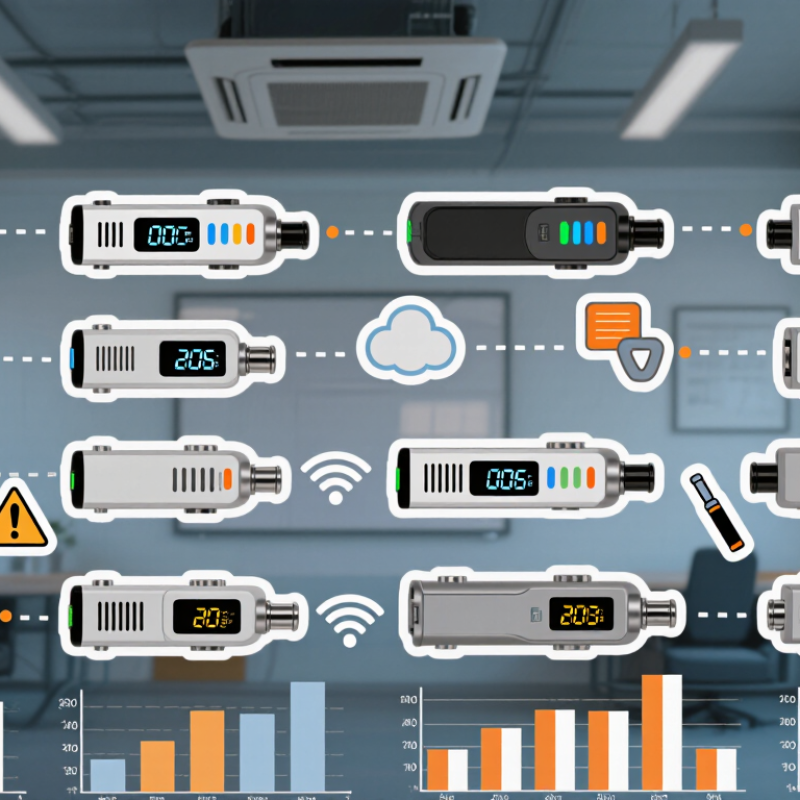
Vaping sensors detect changes in indoor air, not a person’s intentions. Most use optical particle sensors: a small light beam scatters when airborne droplets pass through it. The sensor turns that scattered light into an estimated particle concentration, often reported as PM2.5. Some systems add volatile organic compound or humidity readings to help interpret the signal. A sudden particle spike near a doorway may be a clue. It is not proof.
The National Academies’ 2018 review examined more than 800 studies and reported that e-cigarette aerosol can raise indoor particulate matter and nicotine levels. That matters because a particle sensor may detect the aerosol, but it cannot identify its source by itself. Cooking, cleaning sprays, and outdoor pollution can also trigger readings. VOC sensors have a similar limitation: they respond to groups of gases, not one unique signature. Useful, but imperfect.
For buyers, check what the device actually measures, its detection threshold, and how it handles humidity. A sensor with event logs can help facility teams compare readings across rooms and times. Calibration matters, too; a dusty lens or poor airflow can distort results. The readings are not magic. The World Health Organization’s 2023 e-cigarette report also notes that emissions vary by device and use conditions, so one universal alarm threshold may not fit every space. Combine sensor data with ventilation checks and clear operating procedures.
China’s vaping-sensor sector draws on China’s broader electronics and component supply chain. Its main product types include optical particle sensors, pressure and airflow sensors, temperature sensors, humidity sensors, and selected gas sensors. Each serves a different measurement task. Optical units estimate airborne particle levels, while pressure sensors register changes in airflow. Temperature sensors monitor heat stability, and humidity sensors help identify moisture that can affect readings.
China’s National Bureau of Statistics reported that value added in computer, communication, and other electronic equipment manufacturing grew 3.4% in 2023. This official figure describes a broad manufacturing category, not the vaping-sensor market alone. It offers useful context for buyers assessing local production capacity, but it should not be treated as a sensor-market forecast. Sensor performance also depends on calibration, housing design, and operating conditions.
Tips: Ask suppliers for calibration records and test data across different humidity levels. Compare response time, measurement range, and drift—not just quoted accuracy. Optical readings can shift with particle size and moisture. A limitation worth noting: published, independently verified data for this specific sensor segment remain scarce.
The table below summarizes ten sensor categories relevant to detecting or monitoring vaping aerosols. It is a product-category overview, not a ranked list of manufacturers. Most environmental sensors can detect indicators associated with vaping but cannot identify vaping on their own.
| No. | Sensor category | What it measures | Common sensing principle | Relevance to vaping monitoring | Key limitation |
|---|---|---|---|---|---|
| 1 | Optical particulate matter sensor | Suspended particles or droplets, often reported in particle-size bands or estimated mass concentration | Light scattering from particles passing through an illuminated sensing volume | Can register changes when aerosol is present in the sampled air | Does not identify the aerosol source; readings can be affected by humidity and other particles |
| 2 | Metal-oxide semiconductor VOC sensor | Broad changes in concentrations of certain volatile compounds | Gas-induced changes in the electrical resistance of a heated metal-oxide sensing layer | May provide a general VOC-related signal for combined monitoring systems | Typically cross-sensitive to multiple gases; a signal is not proof of vaping or a specific compound |
| 3 | Photoionization detector (PID) | Ionizable volatile organic compounds, generally as a broad response | Ultraviolet light ionizes compounds with ionization energies below the lamp energy; the resulting current is measured | Can be used to monitor changes in some VOCs in air | Does not measure all VOCs and does not normally identify individual compounds without additional analysis |
| 4 | Electrochemical carbon monoxide sensor | Carbon monoxide (CO) | An electrochemical reaction produces a current related to the gas concentration | Useful for indoor air-safety monitoring as part of a broader sensor system | CO is not a specific marker of vaping; it should not be used alone to detect vaping |
| 5 | NDIR carbon dioxide sensor | Carbon dioxide (CO₂) | Measures infrared absorption at wavelengths associated with CO₂ | Can supply room-ventilation or occupancy context for environmental monitoring | Does not directly detect vaping aerosol |
| 6 | Formaldehyde sensor | Formaldehyde (HCHO), when the sensor is designed and calibrated for it | May use electrochemical, metal-oxide, or optical measurement, depending on the sensor design | Can support targeted indoor-air-quality measurements | Performance and selectivity vary by design; presence alone does not establish a vaping source |
| 7 | Temperature and relative-humidity sensor | Air temperature and relative humidity | Electronic temperature and humidity elements, commonly resistive or capacitive | Provides environmental context and helps interpret particle-sensor readings | Does not detect vaping; humidity can influence some particle measurements |
| 8 | Differential-pressure or airflow sensor | Pressure difference or air movement through a defined flow path | Measures pressure across a restriction or uses a thermal airflow element | Can monitor airflow in an instrument or device when integrated into a suitable design | Airflow alone does not show what substance is present or whether vaping occurred |
| 9 | Photoelectric smoke detector | Light-scattering or light-obscuration changes in a detection chamber | A light source and photosensor detect changes caused by airborne particles | Some aerosol events may affect readings, depending on the detector and conditions | Designed for smoke/fire detection, not vaping identification; performance with vaping aerosol is not consistent enough to infer a source |
| 10 | Electrochemical gas sensor array | One or more target gases, depending on the installed sensing cells | Gas-specific electrochemical reactions generate measurable electrical signals | Can combine selected gas measurements with particle and environmental data | Each channel has specific targets, calibration needs, and potential cross-sensitivities; the array is not automatically vaping-specific |
For robust monitoring, systems typically combine particle measurements with selected gas and environmental readings, then validate performance under the intended indoor conditions. Sensor output should be interpreted as an indication, not definitive identification, unless the complete system has been specifically validated for that purpose.
Assessing a Chinese vaping sensor manufacturer starts with the measurement need, not the product catalog. Define what the sensor must detect, its operating range, response time, and expected environment. Request a datasheet listing units, test conditions, tolerance, and drift over time. Look for repeatable test results rather than impressive claims alone. Small details matter.
Request sample units and test them against a known reference under realistic conditions, including changes in temperature and humidity. Record readings across several runs; one successful test proves little. Ask how each production lot is calibrated, how out-of-range units are handled, and whether records can be traced by serial number. Check connector types, enclosure materials, and installation guidance too. These affect integration.
A factory review should cover incoming-component checks, final inspection, defect handling, and change control. Ask who provides technical support, how quickly engineers answer questions, and what the quoted lead time assumes. Compare offers using the same specification, including packaging, sample charges, and tolerances. Clear documents beat vague assurances. No checklist is perfect. Polished samples may not represent routine batches, so verify critical performance with a pilot order. Set written acceptance criteria before scaling; this takes extra effort, but it can prevent costly surprises.
China’s vaping sensor manufacturers serve different needs, from compact detection modules to complete indoor air-monitoring systems. One profile focuses on optical particle sensing for quick response. Another pairs particle readings with temperature and humidity data. A third builds wall-mounted units for offices and shared buildings. A fourth emphasizes portable devices for inspection teams. A fifth develops sensor modules that equipment makers can integrate into larger systems.
A sixth profile specializes in multi-sensor calibration and repeatability testing. A seventh offers connected monitors with basic data dashboards. An eighth concentrates on low-power designs for battery-operated equipment. A ninth supports custom housings and cable layouts for installation projects. A tenth combines detection hardware with maintenance support and replacement parts. These are useful distinctions, not a verified ranking; capabilities vary by factory and model.
Buyers should request test methods, response-time data, operating ranges, and sample reports before comparing quotations. Ask how a device distinguishes aerosol events from dust, steam, or cooking particles. That detail matters. Review calibration intervals and performance across changing airflow, too. A polished specification sheet is not proof of field reliability. No sensor is perfect. One practical weakness is that product data may omit long-term drift, so independent trials in the intended room can reveal gaps. Check documentation carefully, and confirm that the proposed device suits the monitoring purpose.
Normal boiling points of pure substances commonly referenced in e-liquid formulations, at approximately 1 atm. These are reference properties—not recommended device temperatures or the boiling points of e-liquid mixtures. Glycerol may decompose when heated.
Global buyers should compare vaping sensor suppliers by more than detection claims. Ask for raw data. Request sensitivity, response time, false-alarm rates, operating range, and calibration intervals. Check calibration logs. Test units in the intended room, with changing airflow, humidity, and background particles. A sensor that performs well in a clean laboratory may behave differently near a doorway or ventilation outlet. Ask suppliers to explain those limits, not just show a polished dashboard.
Compliance checks should cover documented quality systems, electrical safety, electromagnetic compatibility, and traceable test methods. The U.S. EPA’s Enhanced Air Sensor Guidebook (2022) recommends evaluating sensors in their intended use conditions and comparing readings with reference instruments where appropriate. The WHO’s 2021 Global Air Quality Guidelines set an annual PM2.5 guideline of 5 μg/m³. That is useful context for particle measurements, but it is not a universal vaping-event threshold. Buyers should verify that suppliers distinguish these measurements clearly.
One uncomfortable point remains: impressive accuracy claims can be hard to compare when test conditions differ. Request complete reports, sample logs, and corrective-action records before accepting a specification.
