
China has become the main production base for large-format LCD panels, but “top manufacturer” depends on what is being measured. Omdia’s LCD Supply Demand & Equipment Tracker has placed mainland China’s share of global LCD manufacturing capacity at roughly 70% in recent forecasts. That is substantial. Yet capacity is not the same as actual output, sales, or IPS panel quality.
This distinction matters when comparing BOE, TCL CSOT, Tianma, and other Chinese suppliers. Their strengths vary by application, from desktop monitors and televisions to industrial displays. Omdia’s capacity tracking, DSCC’s Quarterly Display Fab Utilization Report, and TrendForce’s display market research offer useful evidence on production scale, utilization, and market shipments. Together, these sources help separate factory size from real-world performance. A large fab alone does not prove better color consistency, viewing angles, response time, or long-term reliability.
This article examines who leads China’s IPS panel market and why. It considers production capability, product coverage, customer applications, and available market data. Comparisons still have limits. Public reports do not always isolate IPS technology from other LCD modes, and manufacturers may describe specifications differently. That makes a simple league table imperfect. Readers should treat rankings as evidence-based comparisons, not guarantees of performance in every product.
An IPS (in-plane switching) panel is a type of LCD, not a light source on its own. A backlight shines through liquid-crystal layers and color filters to form the image. In an IPS design, electrodes create an electric field along the panel plane. That field turns the liquid-crystal molecules sideways, controlling how much backlight passes through the polarizers. Pixels combine red, green, and blue subpixels; varying their light output produces the colors on screen. This happens rapidly, line by line, as the display receives image data. Simple, but precise.
Because the crystals move within the plane, IPS panels often keep colors and brightness more consistent off-center than some other LCD designs. That matters when two people watch from a sofa, or when a technician checks a gray test image from the side. The exact result still depends on panel quality, backlight, surface coating, and calibration. IPS is not self-emissive, so dark scenes can look gray if light leaks through the panel. Response speed and contrast also vary; the label alone cannot predict them. A specification sheet helps, but viewing a moving scene and testing in a dark room reveal more. No panel is perfect.
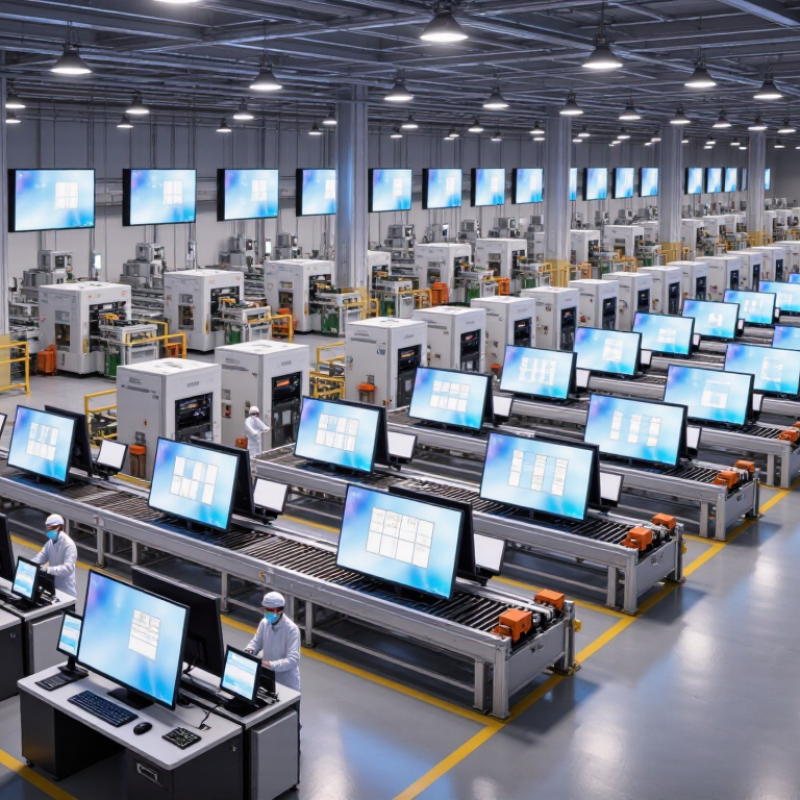
China’s IPS panel industry is organized as a connected supply chain, not a single factory category. IPS is a liquid-crystal display mode; panel makers build LCD cells, then module suppliers add backlights, frames, and connectors. Upstream firms provide glass, polarizers, color filters, and driver components. Assembly clusters near major production hubs, helping reduce transport time between plants.
Omdia’s 2024 display-capacity outlook estimates mainland China holds about 70% of global LCD capacity. Capacity is not the same as actual output, though. Large glass-generation fabs make panel cells, while downstream facilities cut, test, and assemble them for monitors, televisions, and other devices. Regional supply networks around the Yangtze River Delta, Pearl River Delta, and Chengdu-Chongqing area support this division of work. The map looks tidy on paper. Sourcing can be less tidy.
Tips: When comparing suppliers, ask about panel mode, glass size, annual capacity, and module integration. Also check whether quoted capacity is installed capacity or shipped output. A bright sample on a desk proves little about production consistency. I would verify yield and lead-time data directly; these figures can change, and public reports rarely show every factory’s current operating rate.
Leading IPS panel manufacturers in China are best judged by production consistency, not promotional claims. A capable supplier should control cell processing, color calibration, and module assembly, or clearly disclose which stages are outsourced. Buyers can request samples from multiple production batches and compare brightness uniformity, viewing angles, color shift, and dead-pixel rates. A white test image often reveals cloudy corners that polished product photos conceal.
Factory scale matters, but it is only one signal. Check whether the manufacturer can provide traceable test records, stable supply schedules, and realistic support for custom sizes or interfaces. Ask how panels perform after heat, humidity, and extended operating tests. Details matter. A specification sheet may list wide viewing angles while overlooking inconsistent backlighting. That is easy to miss. Chinese suppliers vary widely in engineering depth, so a “leading” position depends on the application: signage, medical displays, or everyday monitors need different reliability and color targets. Independent sample testing remains worthwhile, even when documentation looks complete.
Chinese IPS panel manufacturers differ less by the word “IPS” than by how they control image quality, production, and delivery. One supplier may prioritize high refresh rates for desktop monitors, while another focuses on stable color and thin modules for laptops. Backlight design, optical films, cell alignment, and factory calibration all affect what users see. The differences show. A viewing-angle claim alone says little about brightness uniformity across a large screen.
Their target markets shape engineering choices. Consumer displays often emphasize resolution, response time, and cost. Industrial and commercial panels may instead need higher brightness, wider operating temperatures, or long-term availability. A display installed in a sunlit kiosk, for example, faces different demands from one used in a home office. Custom sizes and interface options can matter as much as headline specifications. Still, longer product availability can mean fewer rapid upgrades.
Comparisons should use the same test conditions. Ask for sample measurements of color uniformity, dead pixels, and brightness variation, rather than relying only on a specification sheet. Review how the supplier handles revisions and production consistency. That comparison is imperfect: sample results cannot guarantee every production batch. A careful assessment should also consider the panel’s intended use, not just its lowest quoted price.
IPS panels are commonly specified at up to 178° viewing angles in both directions, supporting consistent viewing across a wider range of positions. This can suit monitors, laptops, and TVs. Values shown are representative published specifications, not guarantees for every panel; actual performance varies by model.
When evaluating an IPS panel manufacturer in China, look beyond a polished product sheet. Ask for measured viewing angles, color gamut, brightness uniformity, response time, and operating temperature. Check whether these figures describe typical performance or guaranteed limits. A wide viewing angle sounds useful, but poor brightness uniformity can still make one side of a screen look dull.
Request samples from the intended production line, not only hand-selected units. Test them with your own controller and cables, then inspect white and gray screens for tint, dead pixels, and uneven backlighting. Keep notes on the test setup; results can change with brightness, temperature, and measurement tools. Small details matter. Ask how the manufacturer tracks panel revisions, incoming materials, and defects. A clear answer should include records or a practical explanation, not just reassurance.
Communication is part of quality. Send a drawing with dimensions, connector position, and mounting-hole locations, then see whether the technical team flags conflicts before sampling. Ask about pilot-batch inspection, packaging, and realistic lead times. Compare the sample with the agreed specification after a production run. No checklist catches everything. A supplier may have strong equipment and still miss a requirement in a rushed project; that deserves honest review, not an excuse.
Use this evaluation matrix to compare manufacturers without relying on brand claims. The weights are illustrative and should be adjusted to the application; they are not a ranking of specific companies.
| Evaluation Dimension | Suggested Weight | What to Evaluate | Evidence to Request | Practical Evaluation Method |
|---|---|---|---|---|
| Product and format coverage | 15% | Availability of the required diagonal sizes, resolutions, aspect ratios, brightness levels, interfaces, and touch options. | Current product specifications, mechanical drawings, interface details, and a written confirmation of configuration options. | Check that the proposed panel fits the enclosure and supports the host system, operating conditions, and intended use. |
| Optical performance | 20% | Brightness, contrast, color gamut, color consistency, viewing-angle performance, and response time for the intended application. | Datasheets with measurement conditions, sample test reports, and defined acceptance limits for key optical parameters. | Test samples with consistent equipment and settings. Treat viewing-angle figures, including commonly quoted values such as 178°, as model-specific specifications to verify. |
| Panel consistency and yield control | 15% | Variation between samples and production lots, including brightness uniformity, color shift, and pixel-defect handling. | Incoming and outgoing inspection procedures, lot-traceability records, and a written pixel-defect policy. | Compare multiple samples and request agreed acceptance criteria. Confirm whether inspection methods follow a recognized display evaluation standard or a contract-specific specification. |
| Manufacturing capability | 15% | Whether the supplier manufactures the panel, integrates modules, or sources components; assess process control and ability to meet forecast demand. | Facility and process information, production-flow overview, capacity assumptions, and clarification of outsourced operations. | Use a factory or process audit when appropriate. Confirm that the quoted capacity applies to the exact panel configuration and production schedule. |
| Supply continuity and lifecycle | 10% | Lead-time stability, component availability, product-change control, and plans for end-of-life products. | Lead-time commitments, forecast and order terms, change-notification procedure, and product-lifecycle or last-time-buy policy. | Discuss forecast changes and allocation scenarios. Put notification periods and replacement or last-time-buy arrangements in writing. |
| Quality management and traceability | 10% | Documented quality controls, corrective-action process, calibration practices, and traceability from incoming materials to shipped lots. | Quality-system certificate and scope, inspection records, sample corrective-action reports, and lot-label examples. | Verify certificates with the issuing body where relevant, and assess whether documented controls cover the actual manufacturing and inspection sites. |
| Regulatory and material compliance | 10% | Compliance requirements relevant to the destination market and final product, including applicable substance restrictions and documentation. | Current declarations, test reports where required, material information, and identification of the product or configuration covered. | Match documents to the exact model and intended market. Confirm whether requirements apply to the panel alone or to the finished product. |
| Engineering and after-sales support | 5% | Technical response quality, sample support, failure analysis, firmware or interface assistance, and escalation process. | Named technical contacts, support terms, response-time commitments, and a sample issue-resolution workflow. | Run a technical question-and-answer review during sampling and confirm how defects, returns, and corrective actions will be handled. |
| Total review weight | 100% | Adjust the weighting for the project. For example, color and uniformity may matter more for professional displays, while lifecycle and supply continuity may matter more for long-running products. | ||
IPS is a liquid-crystal display technology. Performance and availability vary by panel model and configuration, so compare verified specifications and production samples rather than assuming that every IPS panel has the same characteristics.
